The History of Jonestown
Jonestown was once home to prominent early Americans—including Charles Carroll, a signer of the Declaration of Independence—before becoming a hub for immigrant communities. By the mid-19th century, the neighborhood had developed a strong Jewish character, with many synagogues and Jewish institutions anchoring daily life in the area.
In addition to the Lloyd Street Synagogue and what is now B’nai Israel, Jonestown was home to several other synagogues, including those at 15–21 Eden Street and 16–18 Exeter Street. Known locally as the Eden Street and Exeter Street Shuls, these buildings housed congregations such as Oheb Israel, Aitz Chaim, Anshe Neisen Nusach Ari, and Chizuk Amuno. Chizuk Amuno temporarily worshipped at the Exeter Street Shul—now a parking lot next to the post office—while its synagogue was being built on Lloyd Street between 1871 and 1876.
Jewish communal life also extended beyond places of worship. In 1919, the Jewish Educational Alliance opened its first building at 1216 East Baltimore Street, offering social, educational, and recreational programming. The Alliance would later evolve into the Jewish Community Center, a vital institution that continues to serve Jewish Baltimoreans to this day.
Jonestown Map
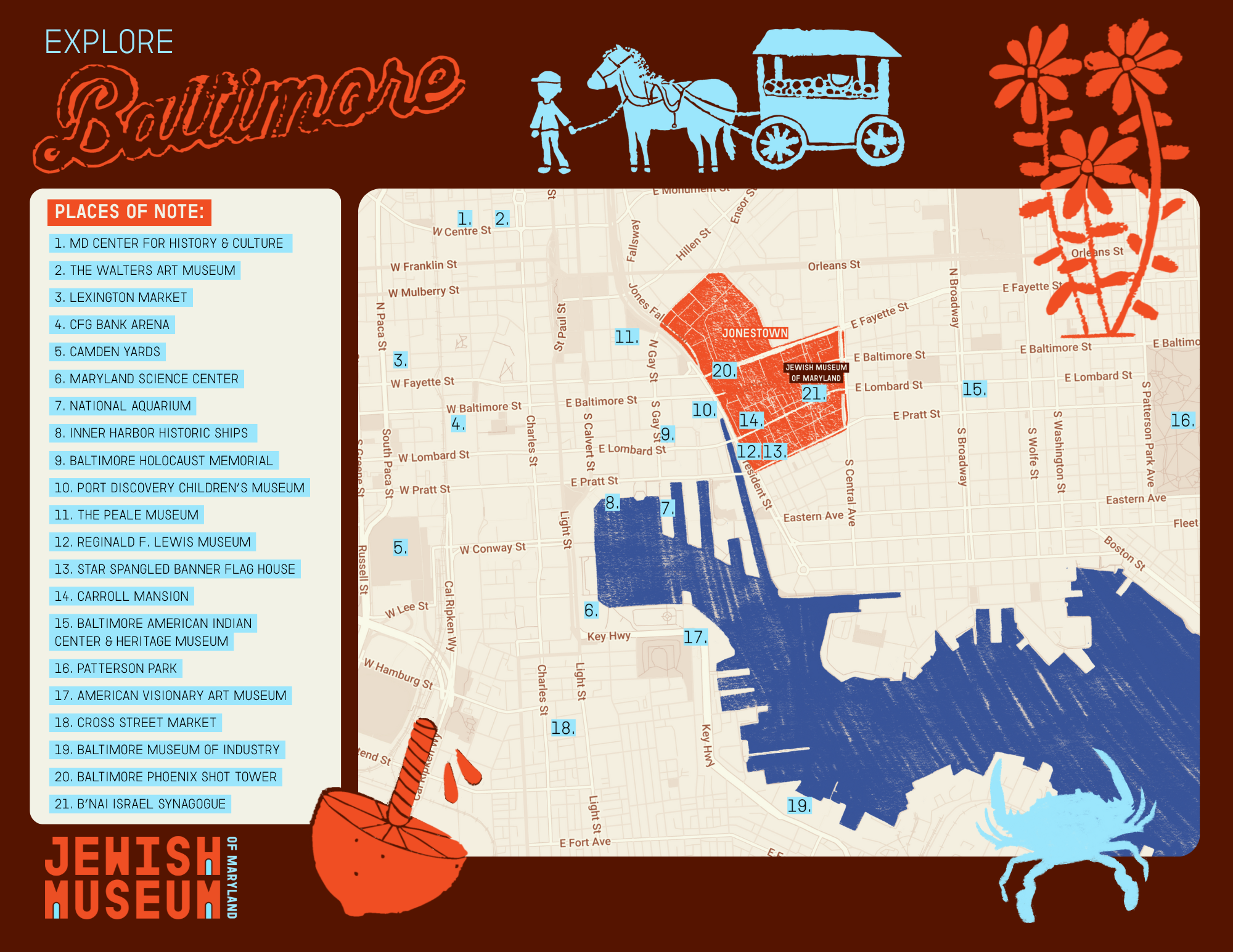
1. MD CENTER FOR HISTORY & CULTURE
2. THE WALTERS ART MUSEUM
3. LEXINGTON MARKET
4. CFG BANK ARENA
5. CAMDEN YARDS
6. MARYLAND SCIENCE CENTER
7. NATIONAL AQUARIUM
8. INNER HARBOR HISTORIC SHIPS
9. BALTIMORE HOLOCAUST MEMORIAL
10. PORT DISCOVERY CHILDREN’S MUSEUM
11. THE PEALE MUSEUM
12. REGINALD F. LEWIS MUSEUM
13. STAR SPANGLED BANNER FLAG HOUSE
14. CARROLL MUSEUMS
15. BALTIMORE AMERICAN INDIAN CENTER & HERITAGE MUSEUM
16. PATTERSON PARK
17. AMERICAN VISIONARY ART MUSEUM
18. CROSS STREET MARKET
19. BALTIMORE MUSEUM OF INDUSTRY
20. BALTIMORE PHOENIX SHOT TOWER
21. B’NAI ISRAEL SYNAGOGUE